
Hubitat Publish Tools Gallery feed (extension)

Hubitat app and driver publishing tools for Visual Studio.
▼ Download- Author
- Mads Kristensen
- Version
- 1.0.38
- Updated
- 22 days ago
- Tags
- hubitat, smart home, automation
- Supports
- VS 2022 VS 2026 VS 2022 (ARM64) VS 2026 (ARM64)
Hubitat Publish Tools for Visual Studio


Download this extension from the Visual Studio Marketplace or get the CI build.
Overview
Hubitat Publish Tools is a Visual Studio extension that streamlines the development and publishing of Groovy-based drivers, apps, and libraries for the Hubitat Elevation platform. Manage hub connections, classify Groovy source files, and publish drivers, apps, or libraries directly from Visual Studio.
✨ Features
- Hub Connection Management — Configure and manage Hubitat hub connections from the Tools menu
- Groovy Source Classification — Detect whether a
.groovyfile is a Hubitat driver, app, or library from its source structure - One-Click Publishing — Publish drivers, apps, and libraries directly to your Hubitat hub
- Compare with Hub — Diff your local Groovy file against the version currently on the hub using Visual Studio's built-in diff viewer
- Replace with Hub Version — Overwrite your local file with the hub's version as a single undo-able edit in the editor
- Connection Validation — Verify hub connectivity before publishing
- Editor Adornment Status — View connected hub publish state directly in the editor (in sync, differs, or not published)
- Publish on Save (Optional) — Toggle automatic publishing from the editor adornment context menu
- Secure Credential Storage — Hub passwords are stored in Windows Credential Manager, not in settings JSON
- Build Integration — Seamlessly integrated commands for Groovy projects
Getting Started
- Install the extension from the Visual Studio Marketplace
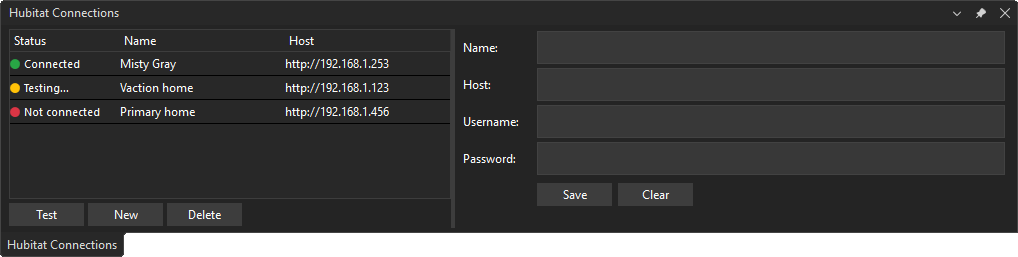
- Go to Tools > Hubitat > Hub Connections to configure your hub settings
- Enter your hub IP address, maker API token, and authenticate
- Right-click on a Hubitat
.groovyfile or use commands to publish it to your hub
If you have more than one connection defined, a dialog shows when you want to publish your driver or app, asking you to chose your connection.
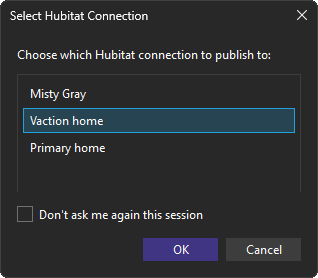
To rename a connection, select it in Hubitat Connections, edit its name, and save. The existing connection and its stored credentials move together; duplicate names are rejected. Removed connections are never reused by the remembered hub selection. Legacy password fields are migrated to Windows Credential Manager without replacing newer stored credentials.
Editor adornment
When you open a Hubitat .groovy file, an editor adornment appears in the bottom-right corner and shows publish status for connected hubs, so you can quickly see whether the local file is in sync with the hub version.
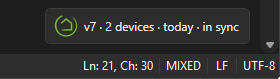
With Publish on Save enabled, saves made during a publish are coalesced into a follow-up publish using the latest file contents. Cancelling target selection stops the publishing indicator and is reported separately from failures.
Compare with hub version
Right-click a Hubitat .groovy file in Solution Explorer and select Compare with hub version to diff your local file against the version currently deployed on the hub. Visual Studio's built-in diff viewer opens with the local file on the left and the hub version on the right, making it easy to review what has changed since your last publish.
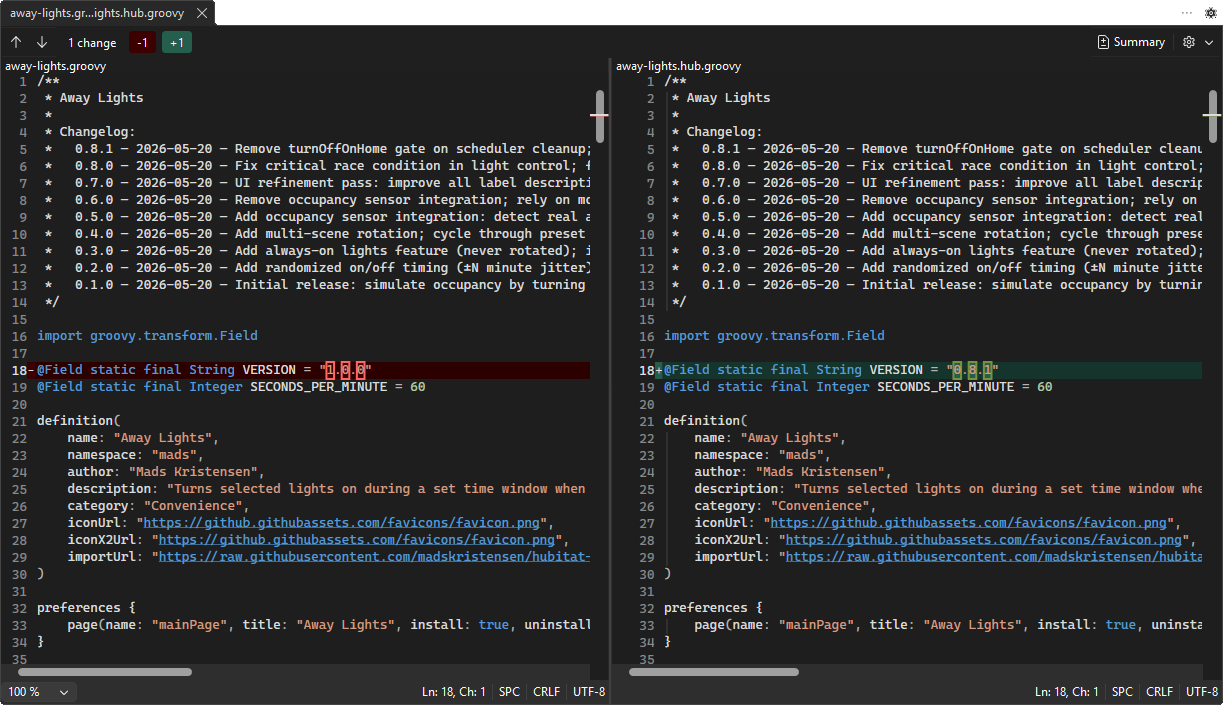
The driver or app must have been published to the hub at least once before comparing.
Building and testing
Use a Visual Studio Developer PowerShell on Windows with the .NET Framework 4.8 targeting pack and the .NET 9 SDK installed:
msbuild HubitatVS.slnx /restore /m /p:Configuration=Release /p:DeployExtension=False
dotnet test test\HubitatVS.Tests\HubitatVS.Tests.csproj --configuration Release --no-build --no-restore --settings test\HubitatVS.Tests\CodeCoverage.runsettings --results-directory TestResults --logger "trx;LogFileName=test-results.trx" --collect "Code Coverage;Format=Cobertura"
CI publishes test results and Cobertura coverage artifacts, and requires at least 39% line and branch coverage. Nullable annotations are supported, but nullable analysis warnings are disabled in both projects.
Support
For bug reports and feature requests, visit the GitHub repository.
Pull requests are welcome!